
App MVP Development Canada
Practical intro
A focused app MVP is not a smaller version of every idea in your head. It is the first useful product system you can ship, test, operate, and improve.
If you already have a brief, wireframes, Figma screens, ChatGPT requirements, workflow notes, screenshots, competitor examples, or a broken product to replace, you are in a better position than most buyers. Clear input keeps the discussion grounded. It helps us identify what belongs in version 1, what should wait, and what needs to exist behind the app for the product to work.
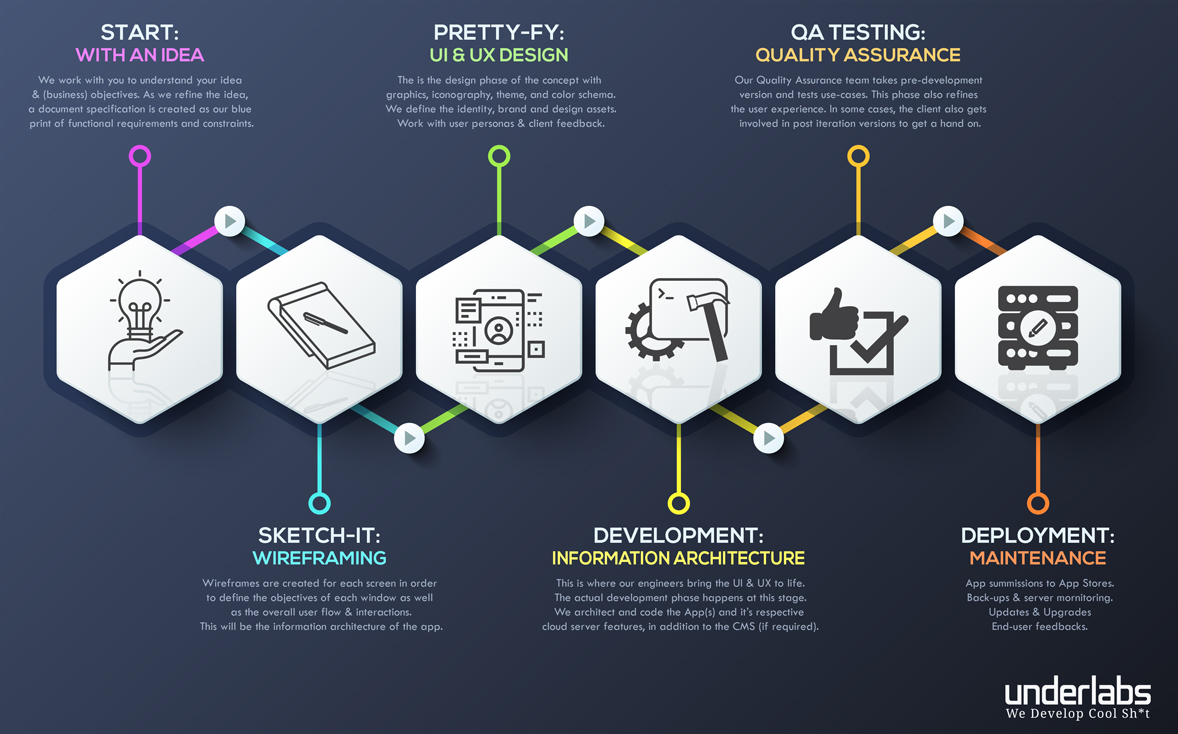
Underlabs builds the product system behind serious apps. The app is only the front door. The real work may include the mobile app, backend, admin tools, dashboards, notifications, analytics, AI features, integrations, releases, and maintenance.
Send us what you have.
We'll tell you what is buildable.
Who this is for
This page is for founders, business owners, and product leads who have moved past the vague idea stage. You may not have a final specification, but you have enough material to start a real product conversation.
You might have a rough app brief, a workflow in Google Docs, a set of Figma screens, sketches from a business process, a ChatGPT-generated requirements document, screenshots of tools your team uses today, or a legacy product that no longer fits.
This is also for teams that know they need help turning scattered requirements into a practical version 1. If you need mobile app development in Montreal with a Canadian product and engineering partner, we can help shape the first release without turning the process into months of abstract discovery.
What buyers usually underestimate
Most buyers start by thinking about screens. Screens matter, but they are rarely the whole product. A login screen implies account rules. A booking screen implies availability, notifications, cancellation logic, admin visibility, and edge cases. A marketplace implies roles, permissions, payments, disputes, fraud handling, and support operations.
The work behind the interface is often what decides whether an app can be operated after launch. A polished prototype can make a product feel simple before the backend, data model, content workflow, and support process have been defined.
That is why app MVP development has to be scoped around the working product, not just the visible app. The useful question is not only what the user sees. It is what must happen before, during, and after each action for the business to run.
The product system behind the app
The app is the front door. The product system is everything required to make that door useful. For some projects, the system is light: a mobile interface, a simple backend, a few admin controls, and analytics. For others, it includes operational dashboards, third-party integrations, internal roles, AI-assisted workflows, reporting, release management, and ongoing maintenance.
A focused version 1 should expose the smallest product system that can prove the core workflow. That does not mean fragile or incomplete. It means choosing the right first slice, building it cleanly, and avoiding features that create complexity before there is enough evidence to support them.
Prepared clients move faster because the product system is easier to evaluate. When we can see your requirements, examples, user roles, workflow notes, and constraints, we can give clearer feedback on what is buildable and what will affect scope.
What Underlabs builds
Underlabs builds mobile apps, backend systems, admin tools, dashboards, integrations, AI features, analytics, notifications, release workflows, and maintenance plans where the product needs them.
Some clients need a consumer mobile app. Some need a field operations tool. Some need a private platform for staff, customers, and administrators. Some need a replacement for spreadsheets, email chains, or an internal system that no longer fits how the business works.
We are most useful when the first release has to connect product thinking with engineering reality. That includes deciding what should be native mobile, what can be web-based, what belongs in the backend, what an admin user needs to manage, and what should be deferred until after real usage.
What a focused version 1 can include
A focused version 1 can include account creation, onboarding, a core user workflow, data capture, uploads, search, notifications, payments, maps, scheduling, chat, reporting, admin review, or AI-assisted actions. It depends on the job the product has to do.
The first version should be narrow enough to build responsibly and complete enough to test the real workflow. If the product requires staff intervention, the admin view matters. If it depends on recurring usage, notifications and analytics may matter. If it uses AI, the review path, failure states, and data boundaries matter.
Focused builds can start around $15k when the scope is clear, the workflow is contained, and the product does not require heavy backend complexity, multi-role operations, advanced AI, or unusual integrations. That is an orientation point, not a promise that every app fits that range.
What affects cost and timeline
The biggest cost drivers are usually not the number of screens. They are the number of roles, the backend rules, the amount of data, the integrations, the approval flows, the AI behavior, the launch requirements, and the maintenance expectations.
A simple app with clear requirements can move quickly. A marketplace, multi-sided platform, regulated workflow, AI-heavy system, or product with complex admin operations takes longer because there are more states to design, build, test, and support.
If you are comparing quotes, it helps to understand why app estimates vary. We wrote more on app development cost in Canada and why apposphere/cost/why app quotes range from 25k to 250k. The short version: clear scope reduces guesswork, but real complexity still has to be paid for somewhere.

Good fit / not a good fit
You have an app idea tied to a real workflow, business process, customer problem, or product opportunity. You can share what you have, even if it is rough. You want help defining version 1, not a long performance around innovation.
You are open to technical pushback. If a feature is better deferred, simplified, or moved into an admin tool instead of the first mobile release, you want to know early.
You need a guaranteed fixed price before the workflow is understood. You want a complex marketplace, AI system, or multi-role platform delivered inside a starter budget. Or you want every possible feature included in the first release because narrowing scope feels uncomfortable.
We can help define scope, but we will not pretend an unclear or complex product is simple just to make the first conversation easier.
FAQ
Can you work from a rough brief or ChatGPT requirements?
Yes. A rough brief, ChatGPT requirements, workflow notes, sketches, Figma screens, screenshots, or competitor examples are useful starting points. We review them to identify the core workflow, missing assumptions, technical risks, and what should be included in version 1.
Do you only build the mobile app?
No. Many products need app backend development, admin tools, dashboards, analytics, notifications, integrations, release support, and maintenance. The mobile app may be the visible part, but the product usually needs supporting systems to operate.
How do you decide what belongs in version 1?
We look at the primary user workflow, the business outcome, the required backend logic, operational needs, launch constraints, and the amount of uncertainty. Version 1 should prove the core job without carrying every future feature from day one.
Can an MVP start around $15k?
Some focused builds can start around $15k when the scope is clear and contained. That usually means a narrow workflow, limited roles, modest backend complexity, and few integrations. Complex apps, marketplaces, AI systems, and multi-role platforms require more budget because there is more to design, build, test, and maintain.
Can you help if we already started and the project stalled?
Yes. We can review a stalled or broken product, inspect the current workflow, identify what is salvageable, and recommend a practical path forward. Sometimes that means repairing the existing system. Sometimes it means rebuilding the right version 1 with clearer boundaries.
What should we send before the first conversation?
Send the brief, workflow notes, Figma link, sketches, screenshots, product examples, user roles, must-have features, known constraints, and anything you already tried. For more preparation, see apposphere/app idea/how to turn an app idea into a real mvp.